

Horizon: Scientists warn Sunak on EU research programme
Prof Sir Adrian Smith told BBC News that reneging on government promises would be damaging to UK science.
His comments follow reports that Rishi Sunak was holding back on re-joining the €95bn programme, known as Horizon.
BBC News understands that he is considering renegotiating a cut-down version of the Horizon programme.
The Royal Society represents Britain's leading scientists. Prof Smith told BBC News that ministers had consistently said that they were fully supportive of full association with the Horizon programme once the EU gave the green light.
"There is a great deal of concern and anxiety at the rumours that there is now a desire to renegotiate our association of the Horizon programme.
"It will mean that the continuing uncertainty will drift on and we will have more of the problems we are already seeing, such as a brain drain and the exclusion of leadership from major programmes," he said.
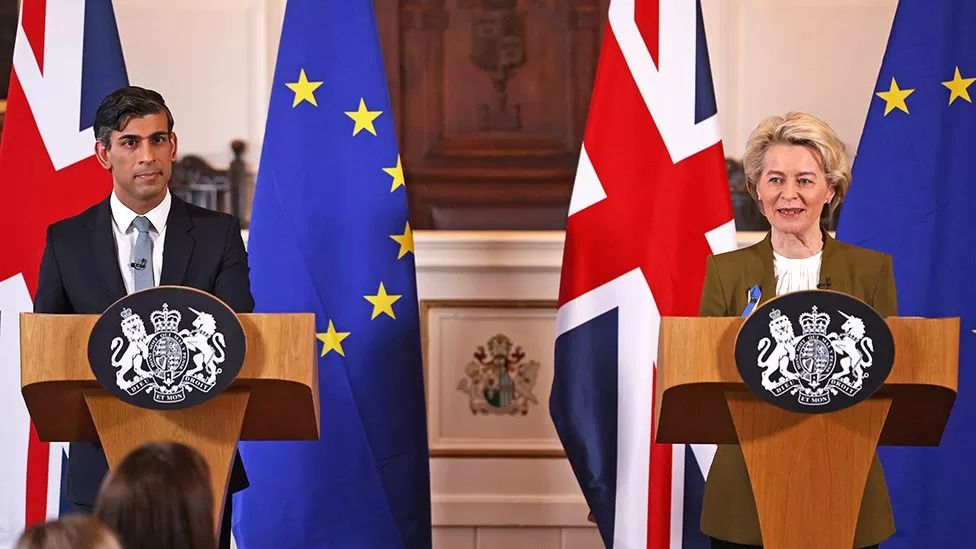 European Commission President Ursula Von der Leyen said talks on Horizon
would begin immediately once the Windsor agreement was implemented
European Commission President Ursula Von der Leyen said talks on Horizon
would begin immediately once the Windsor agreement was implemented
The assumption was that if differences over the Northern Ireland Protocol could be resolved, the UK would fully re-join the Horizon programme under terms similar to those it had before Brexit.
But BBC News understands that Mr Sunak is keen on an alternative research programme put together by ministers, known as "Plan B". This would be a UK-led programme involving collaboration with non-EU as well as European nations. It was developed in case a research agreement could not be reached with the EU.
Sources say that while some aspects of the Horizon programme are appealing to the Prime Minister, such as grants to individual scientists, he believes that larger institutional grants favour France and Germany and may not represent good value for money.
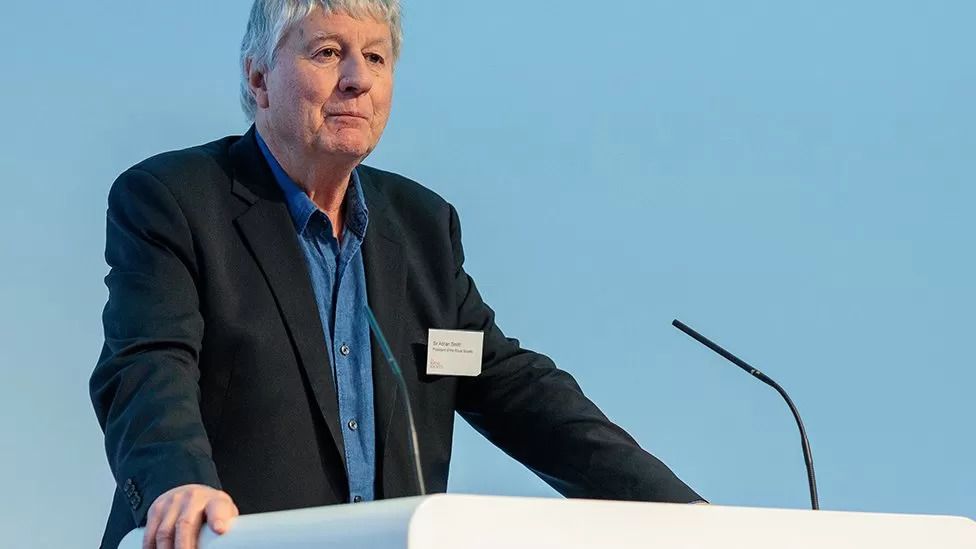 Prof Sir Adrian Smith: ''anxiety and concern'' among the UK's leading scientists
While no decision has yet been taken, one option under consideration is for a complete renegotiation of the terms of the Horizon agreement currently in place with the EU. This would allow the UK government to sign up to those parts of the programme that appealed, then use the remainder of the money that would otherwise have been spent on Horizon on its Plan B.
Prof Smith told BBC News that he didn't believe that such a plan would work.
"There is an assumption that we are in charge of the renegotiation and that we can have the good bits and get out of the not so good bits. All history shows that this kind of cherry-picking and negotiation Is not up for grabs.
''The whole thing is a package and the point is that the entire programme has in the past been good for the UK," he said.
Prof Sarah Main of the Campaign for Science and Engineering said that the UK's previous fruitful membership of the EU programme had attracted investment from the hi-tech companies her organisation represents and that her members want nothing short of the full association that is currently on the table.
"We want to see this with all speed. If the Prime Minister has not been close to the discussion, we need to make clear that that is the message from the research community and in the UK's economic interest to secure this deal as quickly as possible," she said.
Prof James Wilsdon, a specialist in research policy at University College London, said the failure to commit to the current arrangement on offer from the EU showed that the government was not listening to the science community.
"To keep the whole UK research system hanging on in limbo for two years while we ostensibly seek association; then to walk away when we finally have it in our grasp would, I think, be for many UK scientists, the final straw," he said.
Horizon Europe is a collaborative research programme involving Europe's leading research institutes and hi-tech companies. EU member nations each contribute funds which are then allocated to individuals or organisations by expert scientists based on the merit of research proposals.
The government negotiated associate membership of the programme in the withdrawal agreement following Brexit, because it felt it was important for the UK to be involved. But the EU went back on its part of the deal after disputes emerged over the Northern Ireland Protocol and British involvement in the prestigious programme has been left in limbo ever since.
The agreement of the Windsor Framework last week paved the way for the UK to re-join.
When the European Commission President Ursula von der Leyen and the Mr Sunak were asked about re-entry to the Horizon programme at a joint press conference, Ms von der Leyen enthusiastically remarked that it was "good news for scientists and researchers, in the European Union and in the UK," but Mr Sunak did not comment.
He also failed to make a commitment to the programme when asked at Prime Minister's Questions this week and the FT has reported that he was holding back on committing to the programme.
Downing Street has been approached for comment but has not responded.