

Great Britain's high streets lost more than 17,500 chain stores in 2020
More than 17,500 chain store outlets disappeared from high streets, shopping centres and retail parks across Great Britain last year as the Covid-19 pandemic spurred the worst decline on record.
An average of 48 shops, restaurants and other leisure and hospitality venues closed permanently every day across England, Wales and Scotland, and only 21 opened, according to the figures compiled by the Local Data Company (LDC), a research provider, for the accountancy firm PwC.
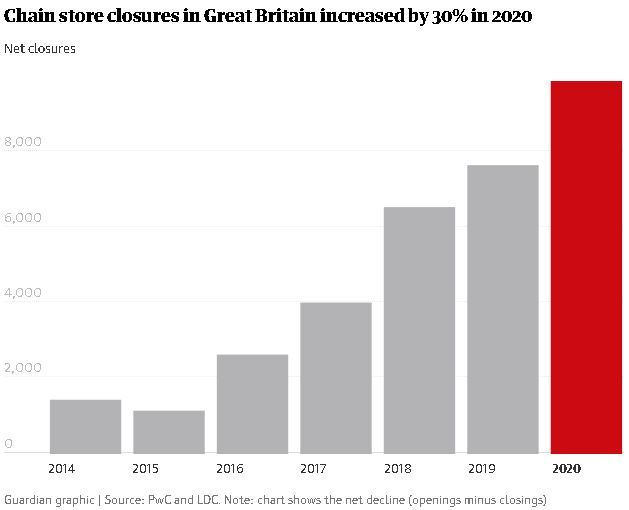
With non-essential shops forced to close during lockdown and a boom in online shopping, as many as 17,532 outlets shut their doors for the last time in 2020. Only 7,655 chain stores were opened. The resulting net closure of 9,877 stores was almost a third higher than in 2019, according to research from almost 3,500 locations, which excludes independent retail outlets and other venues.
The stark figures come before the true impact of the pandemic on Great Britain’s high streets becomes apparent. Many outlets included in the research were temporarily closed during lockdowns and were not counted as shut but may never reopen after restrictions are relaxed this spring.
Non-essential retail is expected to reopen on 12 April in England and Wales and 26 April in Scotland but high streets may look very different after months of temporary closures enforced to prevent the spread of the virus.
The enforced cut-off in store sales has accelerated changes already under way on the high street amid rising costs, a switch to spending on technology and digital services rather than clothing, and a shift to online shopping.
Towns and cities around the country are braced for the permanent closure of major stores, including the entire Debenhams chain and more John Lewis outlets, after eight permanently closed permanently last year, as well as shops such as Topshop and Dorothy Perkins after the collapse of Sir Philip Green’s Arcadia Group.
Lisa Hooker, the head of consumer markets at PwC, said: “The full extent will be revealed in the coming months as many of the [company restructures] and administrations in the early part of 2021 still haven’t been captured, including department stores, fashion retailers and hospitality operators that will leave big holes in city centre locations.”
PwC said it had identified 29 major restructuring plans by retailers, hospitality leisure and other consumer-based companies in the second half of 2020 and it expected more to come.
Fashion retailers were the hardest hit last year, with more than 1,100 disappearing, as names such as Laura Ashley, Warehouse, Oasis and Jaeger exited the high street. Only some Debenhams stores are included in the numbers, and the permanent closure of dozens more as well as Arcadia Group’s brands, including Topshop, Dorothy Perkins and Burton, will be a further blow to town centres this year.
Betting shops, pubs and bars and restaurants were also hit hard, as Burger King, Pizza Express and Pizza Hut all announced some closures last year.
The fastest-growing chains included supermarkets, 88 of which opened, followed by coffee shops, takeaways and patisseries – all groups that had more freedom to trade during the pandemic and benefited from the closure of hospitality venues, as they were mainly classed as “essential”.
Shopping centres were affected more than retail parks, helped by easy access via car parks and more spacious stores – seen as important during the pandemic because of the need for physical distancing.
The biggest rise in vacancies was recorded in Greater London, up 6% from a year ago, amid a more dramatic shift to working from home and lower levels of tourism and day trips than elsewhere, while the east of England fared better than other regions.
The centres of other major cities, including Birmingham, Bristol, Leeds and Newcastle, experienced a decline in the number of chain stores of almost 8%.
In contrast, small towns and suburbs, such as Orpington, Welwyn Garden City, Scarborough, Llandudno and Eastbourne – which have long been in decline at the expense of cities – are enjoying a mini renaissance.
Lucy Stainton, the head of retail at LDC, said the closures told the story of “changing consumer preferences and shifting demand”.
She said: “On the whole, flagship city centre high streets and shopping centres saw a greater decline in chain stores versus more local markets and retail parks, which proved to be more convenient and perceptibly safer. With this in mind, we absolutely believe that after the short-term shakeout, there will be huge opportunity for acquisitive brands who are either looking to launch in different types of locations with new concepts or take advantage of newly available space in their core markets.”