

Fear Grips Hong Kong’s Public Broadcaster
Radio Television Hong Kong (RTHK) is feeling the changes under a newly appointed manager and the city’s new national security law, elevating concerns that the broadcaster will end up more closely aligned with the Communist Party-controlled Hong Kong government.
Last month, the regional Hong Kong government appointed Patrick Li Pak-Chuen, a career bureaucrat with no media experience, as RTHK’s new director of broadcasting. Since then, local media have reported how several shows considered biased by the new RTHK management were suspended by Li, also editor-in-chief.
VOA interviewed a senior RTHK employee familiar with internal discussions at the broadcaster, who asked for anonymity to avoid retaliation and speak candidly. Overall, the source said, RTHK journalists are feeling uncertain about the new management direction and are under pressure to conform.
In response to VOA’s request for comment from the director of broadcasting, RTHK’s head of corporate communications and standards said the broadcaster is “editorially independent as stipulated in the charter of RTHK” that it “will continue to abide by.”
'Repressive' atmosphere
But the RTHK source described the atmosphere as “tense” and “repressive” with a “top-down approach.” Producers must now have current affairs shows preapproved, and directors are asking for more pro-government voices in segments. Even when “impartiality” is demonstrated, the employee said, show ideas are rejected with little explanation.
“They won't tell you the line until they suddenly say you crossed the line, but they didn’t give the details of how the line is crossed — like certain people you can’t interview, that’s all in the dark,” the source said. “Secretive.”
VOA has found it increasingly difficult to contact sources within the broadcaster, with many declining interviews for fear of reprisal.
The fear is that RTHK will end up closer to China’s state-controlled media. “It’s looming over us,” the source said. “There have been some opportunist people who have already offered to produce something that isn’t too far away from propaganda.”
RTHK is Hong Kong’s sole public broadcaster. It launched its first radio program in 1928 under the British Hong Kong Government but later became an independent department. By the 1990s, RTHK was producing web, television and radio content and is bound by its charter to be editorially independent.
The government finances the broadcaster. With an annual expenditure estimated by the Commerce and Economic Development Bureau of about $1.5 billion Hong Kong dollars (U.S. $135 million), the broadcaster produces content for seven radio and three TV stations and provides news services in three languages.
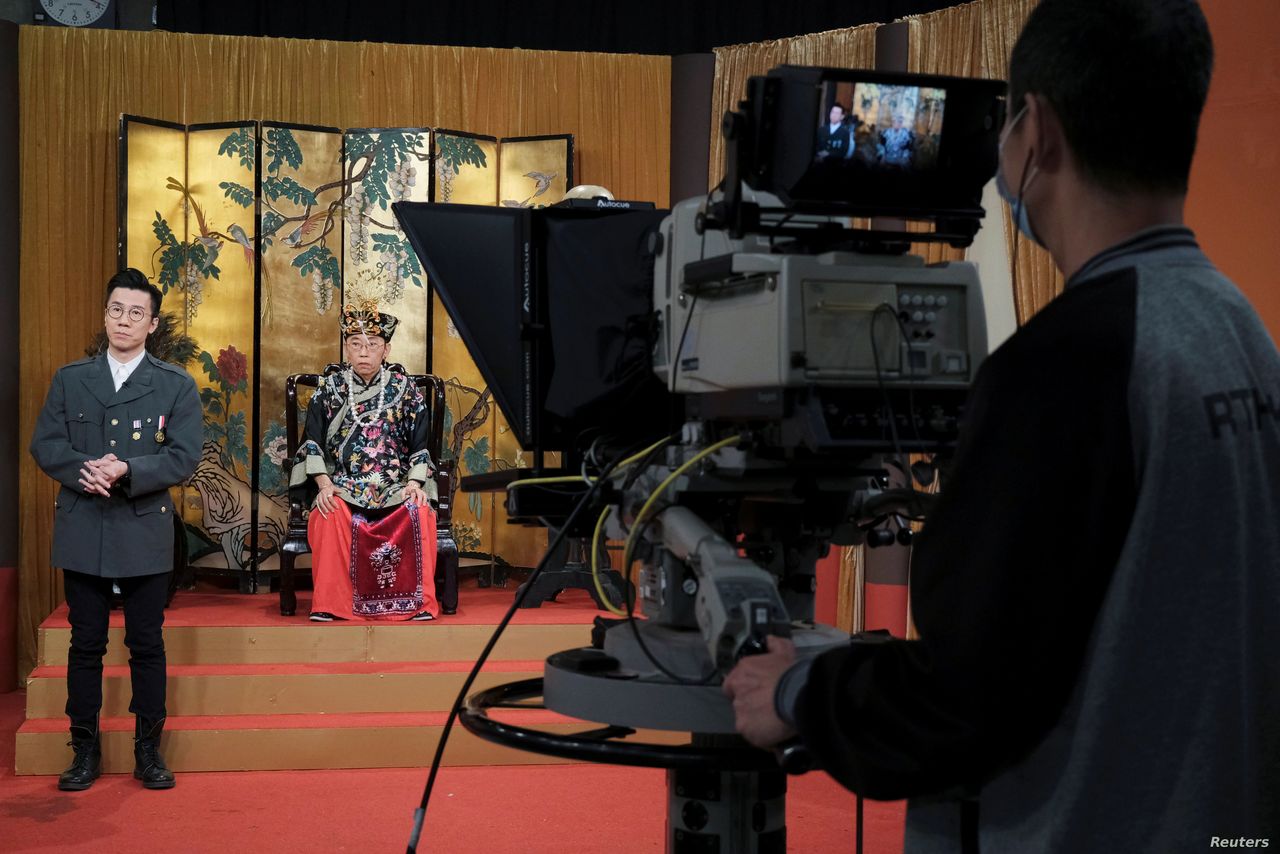 Ng Chi-sam, right, and Tsang
Chi-ho, hosts of RTHK's satirical comedy show "Headliner," perform the
show, in Hong Kong, China, June 5, 2020.
Ng Chi-sam, right, and Tsang
Chi-ho, hosts of RTHK's satirical comedy show "Headliner," perform the
show, in Hong Kong, China, June 5, 2020.
Censorship moves
Politics intruded on RTHK beginning in 2019 as anti-Beijing protests raged. Since then, several shows have been suspended because of perceived government criticism. They include a satirical show, “Headliner,” accused of bias against the Hong Kong police.
An interview with Nathan Law, a prominent, now-exiled activist, was removed from the RTHK website after reports that Law was wanted for violating national security.
Review teams have been set up within the broadcaster to vet future content, and China’s national anthem is now played daily on RTHK radio channels, an effort seen as promoting “patriotism” among Hong Kongers. The broadcaster also followed China’s decision to drop BBC World Service radio broadcasts after criticism by the Chinese government.
RTHK has won international journalism recognition for its coverage during the 2019 protests. But pro-democracy newspaper Apple Daily reported that the broadcaster is expected to decline a Human Rights Award from local journalism groups and Amnesty International. The award is reportedly for RTHK’s documentary on the Yuen Long mob attack against civilians after a protest in July 2019.
The RTHK source told VOA an order to not accept awards or enter journalism contests came “directly from the management” and that the restriction covers all forms of media, including “radio and television.”
The broadcaster’s communications office told VOA an internal review identified that the broadcaster had “room for improvement,” including “the mechanism of nomination of radio and television programmes for local, Mainland [China] and international awards.”
Shaming, criminal charges
RTHK journalists have also come under scrutiny.
Producer Yvonne Tong was publicly condemned by the government for allegedly going against the "One China policy" when discussing Taiwan’s COVID-19 pandemic response with a World Health Organization official.
Program officer Nabela Qoser was hit with complaints from pro-government figures about her direct approach when questioning Hong Kong Chief Executive Carrie Lam at a news conference in 2019. Qoser’s initial employment contract was terminated but she accepted a new short-term deal that added a level of uncertainty to her future with the broadcaster.
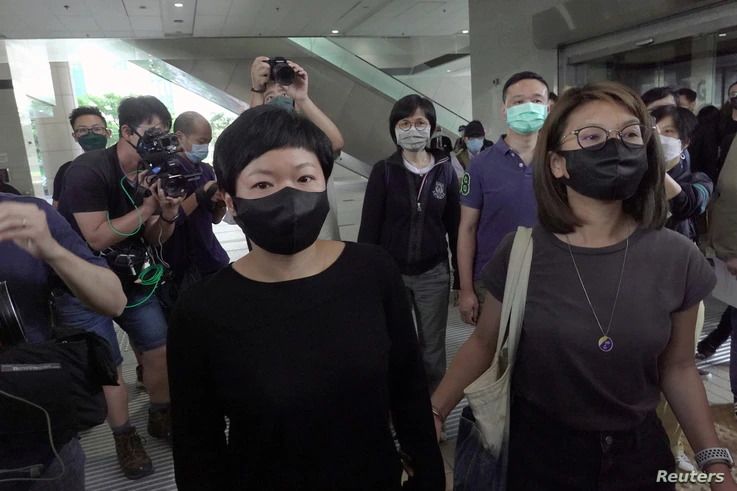 Bao Choy Yuk-Ling, a
freelance producer with RTHK, leaves West Kowloon Magistrates' Courts
after being found guilty of making false statements to obtain data for a
documentary, in Hong Kong, China April 22, 2021.
Bao Choy Yuk-Ling, a
freelance producer with RTHK, leaves West Kowloon Magistrates' Courts
after being found guilty of making false statements to obtain data for a
documentary, in Hong Kong, China April 22, 2021.
And on Thursday, a Hong Kong court found Bao Choy, a freelance producer of the now-award-winning Yuen Long documentary, guilty of illegally obtaining data for the episode. Bao was fined HKD $6,000 (U.S. $773). The documentary highlighted the delayed response by Hong Kong police to the mob attack, in which dozens were injured.
The government has recently called for Hong Kong “patriots” as it pushes to quell unrest in the city. In February, all civil servants, including hundreds of RTHK employees, were asked to sign an allegiance to the government. The fear is that this will allow government critics to be targeted under the new national security law.
Nicholas Cull, a professor of public diplomacy at the Annenberg School for Communication and Journalism at the University of Southern California, told VOA that the “complete integration of media is the long-term goal of Beijing.”
It’s part of a worsening environment globally for media, he said, as broadcasters in Poland, Slovenia and Hungary have been targeted. “In many places, there is an assumption of state control over the public broadcaster,” Cull said.
'Especially dangerous' for journalists
The national security law was described by media watchdog Reporters Without Borders as “especially dangerous” for journalists. It ranked Hong Kong 80th out of 180 countries, where 1 is the most free, in its press freedom index released Tuesday.
The RTHK source who spoke with VOA described a deteriorating situation, with low communication, few meetings, and less transparency and input from senior staff, as “political correctness” becomes the sole consideration for the new director.
“Propaganda is propaganda and reporting is reporting,” the source said. “But then I’d say the boundaries would be blurrier and blurrier, and to the end of that road it could end up being CCTV [China Central Television Network].”

