Banksy is a Bristol-based street artist who has taken the world by storm with his thought-provoking and often humorous works of art.
His identity remains unknown, and speculation about his true identity has been rampant for years.
Peak's fascination with Banksy began when he moved to London's East End in the early 2000s and became intrigued by the graffiti that seemed to be everywhere.
As he delved deeper into the world of street art, he became captivated by Banksy's work and the intrigue surrounding his anonymity.
Peak's podcast aims to provide insights into the man behind the myth, exploring the social commentary and artistic talent that has made Banksy a global phenomenon.
He has spent a year getting to know gallerist Steph Warren, who worked with Banksy at his print house Pictures on Walls in Shoreditch in the early 2000s.
Warren has never spoken publicly about her experiences before, but in the podcast, she opens up about what it was like to work with Banksy and his crew.
Warren recounts the excitement of being involved in the early days of Pictures on Walls, a working-class area that would soon become a hub for street art and hipster culture.
She describes Banksy as being reserved and an observer, someone who had a lot going on in his head and was careful to keep his identity hidden.
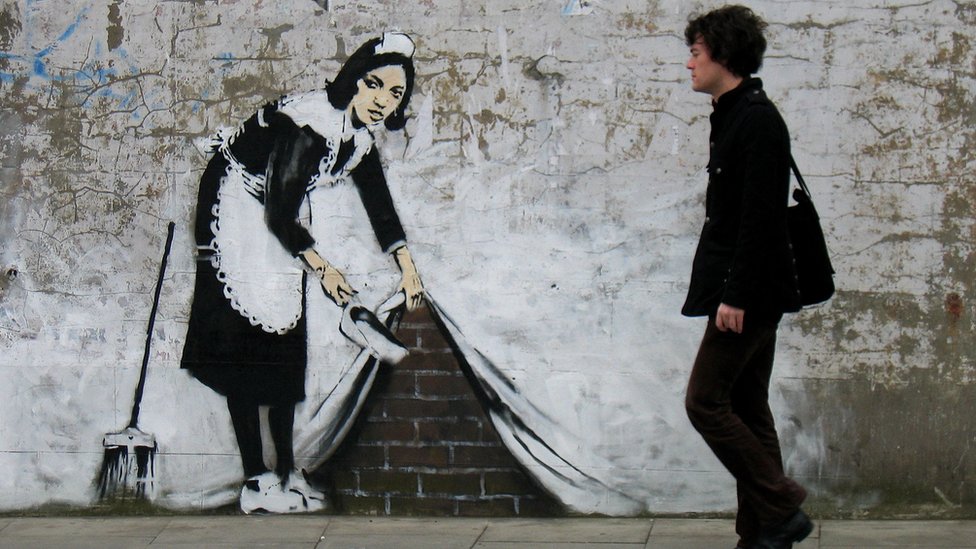
Warren also reveals that she was asked by Banksy to pose for his famous mural Sweeping It Under the Carpet, which depicts a maid at work.
There have been claims that Banksy based the mural on a hotel maid in Los Angeles, but Warren's resemblance to the maid in the mural has led some to speculate that she may have been the inspiration.
The podcast sheds light on the mystique surrounding Banksy and the effort that goes into producing street art undercover to avoid being identified and arrested by the police.
It also explores the idea of whether we need to know who Banksy really is In the late 1990s, Stephanie Warren was working at Pictures on Walls, a now-defunct London art gallery that was once described as "the most famous art gallery in the world." At the time, Pictures on Walls was known for its association with the mysterious street artist Banksy, who was producing some of his most iconic works.
Warren, who was in her mid-20s at the time, was tasked with managing the gallery's day-to-day operations, which included organizing exhibitions, dealing with customers, and handling press inquiries.
However, things were not as they seemed.
Behind the scenes, Warren was struggling with addiction, having become hooked on heroin while working at the gallery.
She claims that the art scene at the time was rife with substance abuse and that she was introduced to heroin while working at Pictures on Walls.
Warren's addiction caused problems in her personal life and professional life, eventually leading to her falling out with Banksy.
In a recent podcast, Warren recounted her time at Pictures on Walls and her relationship with Banksy.
She claims that Banksy was "horrified" when he found out that she was using heroin and took her for a walk to talk to her about it.
However, Warren denied that she was taking the drug at the time.
She also recounted the chaos that ensued during the opening of Banksy's Santa's Ghetto concept store in London in 2006, which got out of hand on its first day with hundreds of people fighting to get in, in the hope of buying one of the artist's limited prints.
Warren had arranged the morning off, but said Banksy was uncharacteristically "fuming" with her because she wasn't there to manage the queue.
In hindsight, she says: "I should have been there, I wasn't exactly a model employee, I was on heroin." Soon after, Warren and Pictures on Walls parted company.
Warren was later accused in the press of fraudulently producing Banksy prints and selling them on, something she has always vehemently denied.
When she wanted to defend herself publicly, she claims Banksy's PR, Jo Brooks, cautioned her against the move
LONDON DAILY ARCHIVE
Exploring the Mystery of Banksy: A New Podcast Hosted by James Peak for BBC Radio 4
A new podcast hosted by street art fan James Peak for BBC Radio 4 aims to uncover the truth about the elusive and mysterious artist known as Banksy.
17 July 2023 · 10:24 UTC