This challenges the previous idea that humans migrated out of Africa in a single wave around 50,000 to 60,000 years ago and suggests that there may have been earlier, unsuccessful migrations.
The findings also suggest that humans were capable of adapting and dispersing through upland forested regions earlier than previously thought.
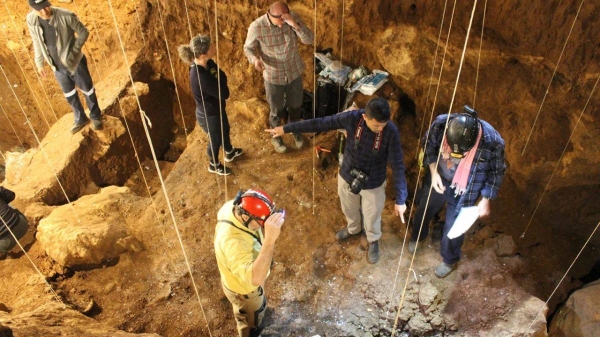
The discovery was made in a cave in Tam Pa Ling, Laos, where seven human fossils have been unearthed, including a leg bone fragment and part of a skull.
The site was dated using two different techniques, which revealed that the fossils were between 68,000 and 86,000 years old.
The discovery of these early human remains in an upland region challenges the idea that humans followed coastlines and island locations in their migration out of Africa.
A tooth believed to belong to a Denisovan, an early human species, has been found at a nearby site called Cobra Cave.
However, this tooth is 70,000 years older than the earliest remains found at the Tam Pa Ling site, suggesting that there is no evidence of mixing or coexistence between the two species.
The world's oldest figurative rock art has been discovered in Indonesia, and extinct human species such as Homo floresiensis and Homo luzonensis have been found on islands in Indonesia and the Philippines.
The team expects to unearth more human fossils from the region.
LONDON DAILY ARCHIVE
Early Humans Migrated Out of Africa in Multiple Waves, Study Reveals
A new study published in the journal Nature Communications has revealed that early humans, specifically Homo sapiens, were living in a region of northern Laos around 86,000 years ago.
14 June 2023 · 22:33 UTC