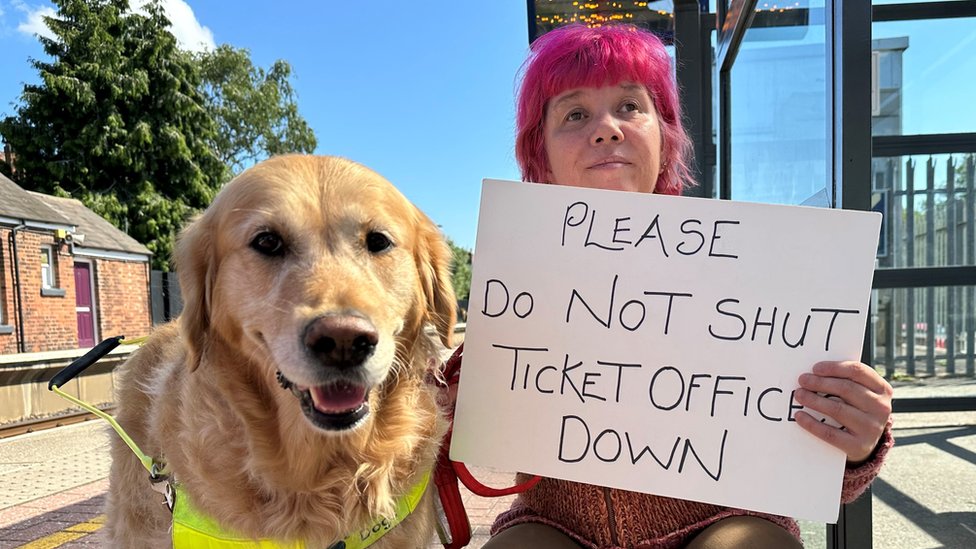
The two activists claim that the consultation process discriminated against disabled people.
The plans, which were announced earlier this month, will see the majority of all ticket offices closed in England over the course of three years, with some kiosks remaining open in larger stations.
The Department for Transport has stated that the goal of the changes is to enhance the role of station workers and to provide assistance to passengers on concourses and platforms.
However, many disabled people have expressed concern about losing a central point of contact at stations.
Sarah Leadbetter, who is blind, and Doug Paulley, a wheelchair-user, have applied for a judicial review on the grounds that the 21-day consultation period was too short and information was not provided in accessible formats such as easy read and audio.
Sarah Leadbetter said that she was not aware of the consultation until after it had ended and that she was worried about the safety of having to navigate the station without a central point of contact.
"I'm a disabled woman standing on a platform by myself with my guide dog, Nellie - how do I know that the person coming towards me, saying they're a member of staff, is actually a member of staff?" she said.
The Rail Minister, Huw Merriman, is set to meet with accessibility groups, and the BBC has learned that the government is considering giving more powers to the regulator to intervene in similar cases.
Five city mayors, who are all Labour, have also prepared legal action over the "totally inadequate" consultation.
The changes are expected to result in a significant loss of jobs, with the Rail Delivery Group estimating that around 300 ticket office staff could lose their jobs.
The government has stated that changes need to be made to ensure that the rail service can "survive." However, many disabled people are worried about the impact of these changes on their ability to travel independently.
James Beardwell, from Witham in Essex, who is autistic and has learning disabilities, has been protesting against the proposed changes outside his local train station.
"I am able to travel independently on the train, but I like that ticket office staff are very clear and they are very helpful A public consultation has been launched by the Rail Delivery Group, which represents train operators, to gather feedback on plans to close or reduce the hours of ticket offices across the UK.
The move is part of a £1.5 billion reform package aimed at improving the railway for passengers, but it has sparked concerns about accessibility and the loss of human contact for disabled and visually impaired passengers.
Ticket machines are currently a flat featureless touchscreen and inaccessible to visually impaired people.
Some people with learning disabilities prefer to use cash, but not all ticket machines accept it.
Closing or reducing hours of ticket offices could also threaten the availability of facilities such as accessible toilets and lifts, which may require staff-held keys to open or operate them.
The loss of a central location where staff could be found means that visually impaired, neurodivergent, and energy-impaired passengers may find it difficult to search for staff, especially if they are overwhelmed by the station environment.
Sassy Wyatt, who lives in Luton and runs Blind Girl Adventures, an accessible tourism consultancy, uses trains several times a week to travel around the UK.
She says that human contact is important to most people and that kiosk staff can inform her of the best ticket deals available, as well as provide knowledge on the accessibility of stations and safely guide her to her platform.
She is "terrified" that visually impaired people will be left to wander along platforms without tactile paving, which could lead to accidents.
The Rail Delivery Group says equality impact assessments have been carried out at every station, and companies will continue to engage with accessibility and safety groups.
The new Passenger Assist app can be used to book assistance, but it defaults to meeting assistants at the ticket office, where humans are.
Sassy has had "really positive experiences" with the app, but it comes with limitations.
The public consultation is due to end on 26 July, and the BBC has launched an accessible podcast to help support and gather feedback from passengers with disabilities.
The podcast can be found on the BBC's Access All page, along with other related internet links.
LONDON DAILY ARCHIVE
Disabled activists launch legal challenge against plans to close railway station ticket offices
Disabled activists Sarah Leadbetter and Doug Paulley have launched a legal challenge against plans by train operators to shut down almost all railway station ticket offices.
22 July 2023 · 02:37 UTC