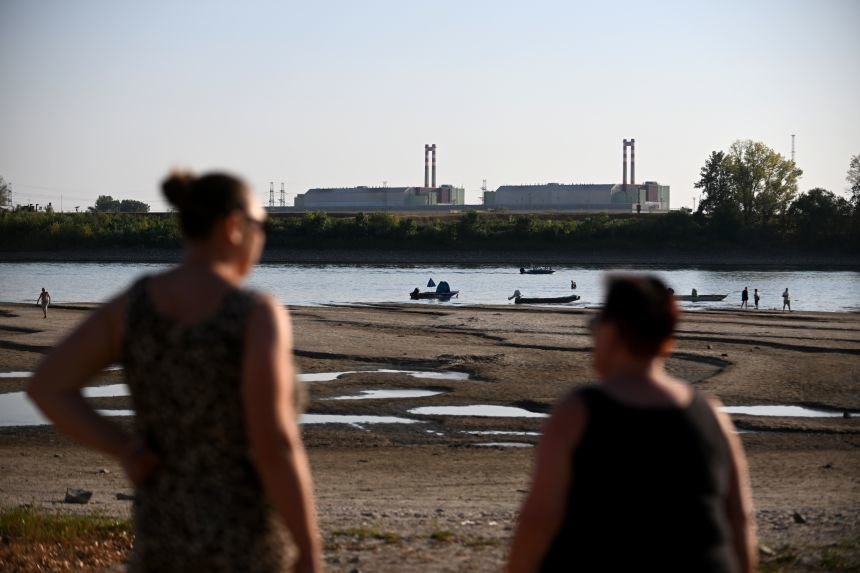
Danube Drought Forces Hungary’s Paks Nuclear Plant Into Full Shutdown
Record-low river levels have halted Paks for the first time in 44 years, triggering emergency measures to protect Hungary’s power grid.
Record-low water on the Danube has forced Hungary to shut down the Paks nuclear power plant in full for the first time in its 44-year operating history, removing roughly 2,000 megawatts from a system that normally draws about two-fifths of its electricity from the facility.
Paks’ four Russian-designed reactors rely on river water for cooling.
Their output was progressively reduced as the Danube fell, leaving the plant generating only 240 megawatts before its final operating unit was taken offline.
The shutdown is tied to insufficient cooling-water intake, rather than a fault at the reactors.
The government has activated an emergency grid protocol, relying on reserve generation and imported electricity while seeking to curb demand.
Large industrial users will be asked to reduce consumption and could face mandatory restrictions or temporary disconnection if voluntary cuts prove inadequate.
Prime Minister Péter Magyar said households would be “the last in the chain of restrictions.”
From Monday, most rail freight services are to stop between 17:00 and 22:00, while public-sector staff will work remotely for the first three days of the week.
The government has also called on private employers to follow where possible and ordered non-essential lighting at public buildings to be switched off.
The drought has disrupted shipping and tourism along the Danube and prompted water-use restrictions in the hardest-hit areas.
Paks may remain idle for weeks if river levels do not recover, leaving Hungary more dependent on emergency generation and electricity imports.
Paks’ four Russian-designed reactors rely on river water for cooling.
Their output was progressively reduced as the Danube fell, leaving the plant generating only 240 megawatts before its final operating unit was taken offline.
The shutdown is tied to insufficient cooling-water intake, rather than a fault at the reactors.
The government has activated an emergency grid protocol, relying on reserve generation and imported electricity while seeking to curb demand.
Large industrial users will be asked to reduce consumption and could face mandatory restrictions or temporary disconnection if voluntary cuts prove inadequate.
Prime Minister Péter Magyar said households would be “the last in the chain of restrictions.”
From Monday, most rail freight services are to stop between 17:00 and 22:00, while public-sector staff will work remotely for the first three days of the week.
The government has also called on private employers to follow where possible and ordered non-essential lighting at public buildings to be switched off.
The drought has disrupted shipping and tourism along the Danube and prompted water-use restrictions in the hardest-hit areas.
Paks may remain idle for weeks if river levels do not recover, leaving Hungary more dependent on emergency generation and electricity imports.