Inside the New Gucci Archive in Florence With Its Maestro Alessandro Michele
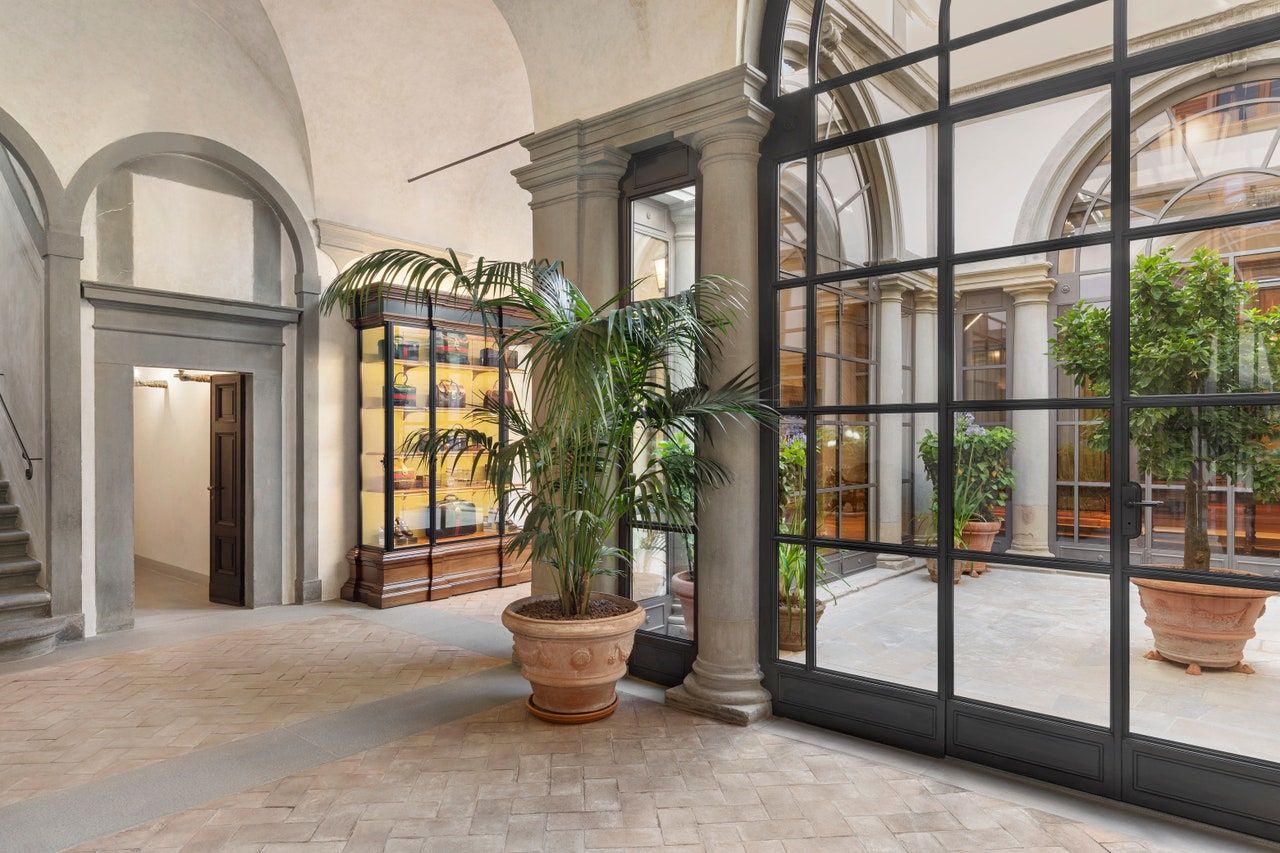
According to Gucci’s Alessandro Michele, archives are living organisms, not mausoleums or frigid clinical spaces where a brand’s history is kept frozen and mummified. A cultivated and eclectic collector and lover of archeology, Michele’s constant dialogue with the past has shaped his work at Gucci, whose 100th anniversary has been celebrated this year. As a cherry on the birthday cake, the Gucci Archive has just opened in Florence. Housed in the Palazzo Settimanni, a Renaissance gem located in the lively Oltrarno neighborhood of Santo Spirito, it has been meticulously restored to its original splendor and refurbished to house the brand’s vast collections.
Gucci acquired the aristocratic Palazzo Settimanni in 1953; throughout the years, it has served as a factory, a workshop, and a showroom. Now, across its five floors, it displays rows of Bamboo and Jackie bags, elegant travel trunks from the ’30s, ’40s, and ’50s, bizarre lifestyle objects, the famous Flora foulards with the original hand-drawn sketches by illustrator Vittorio Accornero, and, but of course, Alessandro Michele’s hyperbolic creations for the likes of Björk and Florence Welch.
Curated with the collaboration of FIT’s Valerie Steele, the archive provides an entertaining experience. The idiosyncratic spirit of Michele seems to preside, rather amused, over the rarefied Renaissance atmosphere of the palazzo. However, with history being questioned and brand legacies being scrutinized-sometimes celebrated, other times ignored or erased-archives are places of meaning. I sat with Michele, to talk about his thoughts on the mysterious life of objects, the shamanic properties of Tilda Swinton, and the many teddy bears populating his childhood, and much more.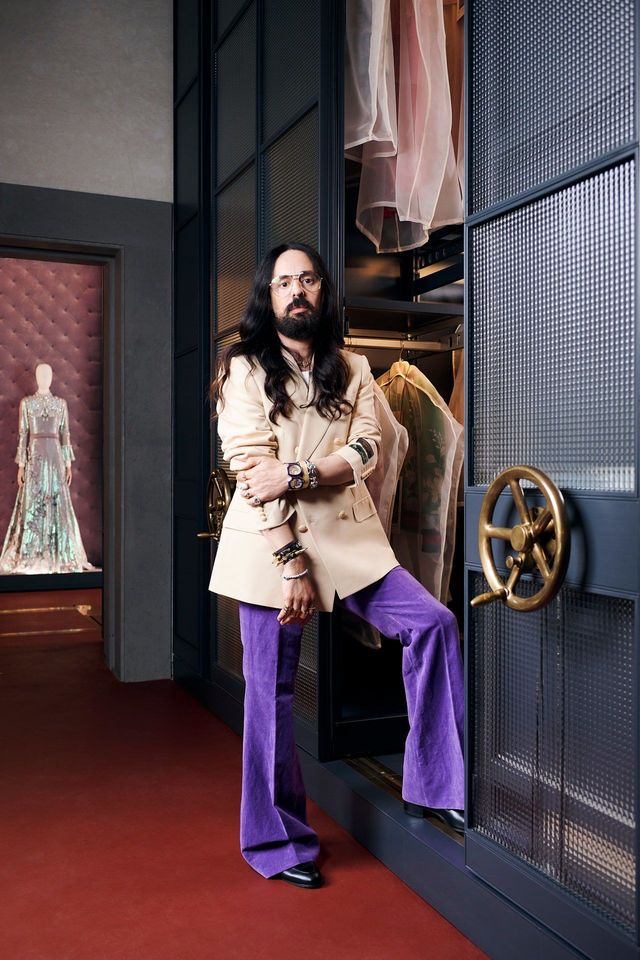
How did you bring the archive to life?
Alessandro Michele: When I arrived at Gucci, this palazzo in Via delle Caldaie was dormant, no one had any idea what to do with it. There was a sort of misunderstanding between the company and this beautiful place. It was like having a Caravaggio painting hung over the sofa at home, thinking it was a copy-but it was actually the original! When I became creative director, Marco Bizzarri asked me, what do you want to do with it? I’d been waiting for that question. So we started working on it, giving it back its dignity, because this is a sancta sanctorum; it was here that Gucci’s fire started burning, so to speak. At that time, when Gucci acquired the building in 1953, turning an historic Renaissance palazzo inhabited for centuries by aristocratic Florentine families into a leather goods workshop was a rather modern gesture, something that today is commonplace. What could’ve looked as an act of social outrage was actually a very clever idea-the idea that the past isn’t something inert, lifeless, and untouchable. Taking over the palazzo also contributed to revitalizing the ancient Santo Spirito neighborhood, full of artisans, blacksmiths, gilders, wood carvers, and goldsmiths, as the Ponte Vecchio is a few steps away. It was smack in the middle of a sort of Silicon Valley of that time. Working at its renovation for me has been pure delight, as I’m a collector and conservator of things-and a contemplator of things; I’ve helped to create the shell in which these beautiful things can be admired over time.
A.M.: Indeed it was. We peeled off the old coatings obfuscating its beauty as a wonderful vessel of history, working with descialbatura, which is a technique used in archeology of delicately removing the layers of paint hiding ancient frescoes. We brought to light incredible original grottesche dating back from the 16th to the 18th century. The palazzo started to talk, to have a voice, as it probably had when it was built in the first place. And finally we brought the bags back home. We put them back where they belong, we put them to bed, we took them back to sleep in their mum’s house. It’s a wonderful thing, it’s an act of affection and love towards the label, towards the job that each of these bags has done in its past, towards the women who have carried them around, who had them travel the world to faraway places… Now they are kept safe and at peace in beautiful linen boxes-I wish I had these very same boxes for all the bags in my own wardrobe.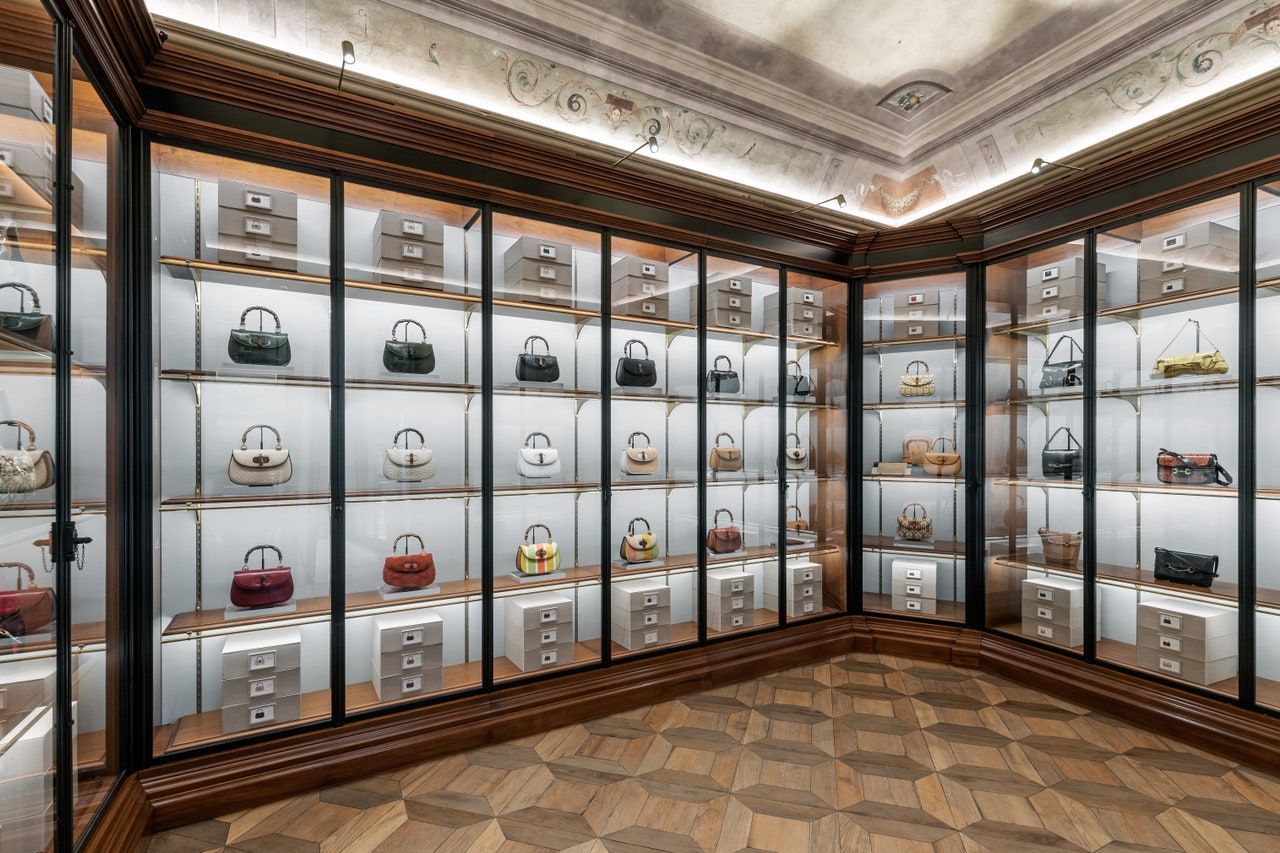
I guess that celebrating Gucci's 100th anniversary opening a place so rich in history has a special meaning for you.
A.M.: When I was appointed creative director six years ago, we didn’t have the time to worry about the archive. There was too much to do, so Palazzo Settimanni had to wait. So it was kept closed and it waited, which I think is a rather beautiful thing. It patiently waited until we had the time, energy, and attention to take care of it. Now it looks beautiful, it has a good Karma, you can feel it as soon as you enter to visit. It also conveys a positive message for Florence, for Tuscany; it’s a message that says quite a lot about the Florentine Renaissance, which has actually produced much more than we think. It hasn’t just produced the visual language of the West, that point of view hasn’t just produced the cinema and the movies, so to speak, but also many other things, hidden, subterranean, and almost undetectable yet very great.
It is indeed true that the space exudes a sense of calm and serenity, very close to the Renaissance idea of equilibrium and beauty. It feels like visiting a welcoming house, not like entering a secluded bank vault or an antiseptic clinical space, like many other brand’s archives I’ve visited.
A.M.: Our approach has been very intimate, I’m used to collecting and keeping things, but not letting them die. My home is full of apparently useless objects which could easily be catalogued and let die a forgotten death. But it isn’t the case with this archive, which has been conceived as an act of love, as when I welcome in my house beautiful things that help me survive—it’s actually me surviving through them, not the other way around. I know, it’s a subtle difference, but it’s important to understand my curatorial approach to this place. It’s a humanistic approach, I’ve given it a life as if it were a home, with all its rooms beautifully restored; I wanted the objects to feel at ease. When I was a kid I always took great care of my many teddy bears, to which I was unfortunately allergic. Each night in turn one of them slept with me; they were lined up neatly on a small side table, each with its own little blanket. I wanted them to be well and feel comfortable. I have a very animistic approach to objects; I think they’re idols, in the ancient etymology of the word, hence I want them to feel good, to be well. This is their home, they’re like wonderful toys deserving serenity and quiet. And every time I’m here, I’d like to open one of those linen boxes, take one of the bags sleeping inside and bring it out for a walk. For me, there’s something vital in the things of the past, especially in everyday objects. Bags are recipients, containers of our lives’ experiences, they’ve taken planes, they’ve checked-in, they’ve seen love stories ending, weddings, divorces… they’re living beings. Those who think that objects aren’t alive are eluding a great truth, however mysterious it may seem.
The many rooms of the palazzo are each named with rather bizarre and wondrous monikers: Serapis, Hortus Deliciarum, Ganimede’s Meadow, Maison de l’Amour. What’s their origin?
A.M. These epithets aren’t immediately linked to descriptive fashion terms, even if I believe that everything is eventually linked to fashion, because fashion is life. Some of the names refer to actual physical places around Florence, names of old botanical or vegetable gardens still existing. Other names derive from the ancient Greek and are evocative of bizarre, strange destinations; they’re names inhabited by a sense of journey, they somehow bring about the magic of mythology. In my six years journey as Gucci creative director, I’ve invented these names to almost map a path, because words and imagination are maps that can be rearranged as we please, they’re at the service of our life.
The idea of a journey definitely comes to mind when you tour the archive, which feels like a modern wunderkammer. The Serapis room in particular is rather spectacular : the metallic parallelepipedon at its center opens up mechanically like a treasure chest, revealing inside the bespoke outfits you’ve designed for Bjork, Florence Welch, or Lana del Rey. It’s reminiscent of the stage sets of baroque theater and their marvelous mechanical machines, isn’t it?
A.M. Indeed. The idea of the wunderkammer is linked to that of travel and, yes, the mechanical box is rather theatrical. I think that fashion is a sort of theater-not in the baroque sense of inducing a sense of wonder, shock, and magnificence, but in that fashion is something that moves, it has an inherent movement, it isn’t still. Fashion objects compose and recompose like our lives. The mechanical box in the Serapis room has certainly to do with the stage outfits it conceals or reveals, but it’s also a metaphor of the lives of those outfits, which is deeply linked to that of the women who wore them. And I like things that apparently seem like one thing and then become another. Lately I’ve been giving much thought to the idea of ambiguity, which is fashion’s most beautiful quality. Ambiguity doesn’t only refer to gender; according to its etymological roots, no one is just one thing but every personality is mercurial, changeable. This is the nature of fashion, and the objects housed in this archive are intrinsically ambiguous, they’ve been inherited from the past but they’re present today in their three-dimensional physical form. You can actually touch them, and metaphorically it’s like if you were touching the past, which has a sort of ambiguous, fascinating connotation.
Talking about the past, its value is being questioned today. Young generations seem to acknowledge only the here and now. To know the past doesn’t seem a necessary tool to understand the present. Making Gucci’s history visible to be read and passed on to young generations-was it one of the purposes of opening the archive?
A.M.: I have an everyday dialogue with the past, which for me has full existence and presence. It just doesn’t make sense to say that the past doesn’t have a dialogue with us; if in this instant I go out the door to take a walk in the Santo Spirito neighborhood, I’m surrounded more by what has been than by what will be. The past is an essential, inescapable constituent of the present. For me, the past is the present-this is my constant assumption. In my creative practice I’m not recovering or recapturing the past. I don’t like to say that I’m recovering the past, because this past is a present that I live always. I myself am a past that speaks to today. The elimination of the past, to erase it-it’s an unnatural process. My partner Vanni has made me understand that I’m using the past as a fuel; it depends on which chemical reagent you put it in contact with. For me the past is a formidable entity, I breathe it like something which exists today. The way I use vintage-it’s like a bridge, if I have to cross a river, will I have to have a bridge to reach the place I want to reach, or not? We’re all on that bridge; let’s see where it leads us. So I invite young people not to be fooled by the bi-dimensional life we live today, but to observe things with care, more deeply and accurately. The dialogue with the past generates great seeds of knowledge. The future we all talk about is perhaps less fascinating than the present, which instead is full and rich with experience-every single minute of it. The patrimony of a fashion brand like Gucci… its rich legacy speaks to you. It’s up to you to listen to it or not. But relationships don’t last very long if you don’t listen and speak to each other.
So you see yourself as a sort of medium between the past and the present…
A.M.: I believe that fashion designers are indeed mediums, yes, because you make objects and dresses that actually speak, they’re idols, they’re talking objects… Recently I went to Rome’s Mattatoio art space to see Tilda Swinton performing Olivier Saillard’s “Embodying Pasolini”; it was about giving new life to the clothes the Italian costume designer Danilo Donati designed for Pier Paolo Pasolini’s movies. It was extraordinary. Tilda didn’t actually wear the dresses, she just laid them on her body, as if they had a life of their own; they exuded a gravitational pull which eludes us, some kind of magical power. It felt like a shamanic ritual. Etruscan priests prophesied by looking at the entrails of animals, their narration was mediated through their energy. When we create dresses and garments, there are stories taking shape through them-obviously they’re just pieces of fabric, someone sewed them. But then there are stories happening and taking shape around them which we narrate, which you in turn will imagine when wearing that dress, through my narration… So to answer your question, yes, we as designers we’re mediums, we’re a connection, a channel with the objects. They look like inanimate things-but they’re not, they help to describe what’s human. What we designers do is an imitation of nature; we’re fond of apparently inanimate things. But we don’t know if they really are or not. Science doesn’t tell us everything.