Air Traffic Control Outage Grounded Flights Across the Midwest
A failure affecting radar and radio communications at a Minneapolis-area control facility disrupted air travel across nine states before systems were restored.
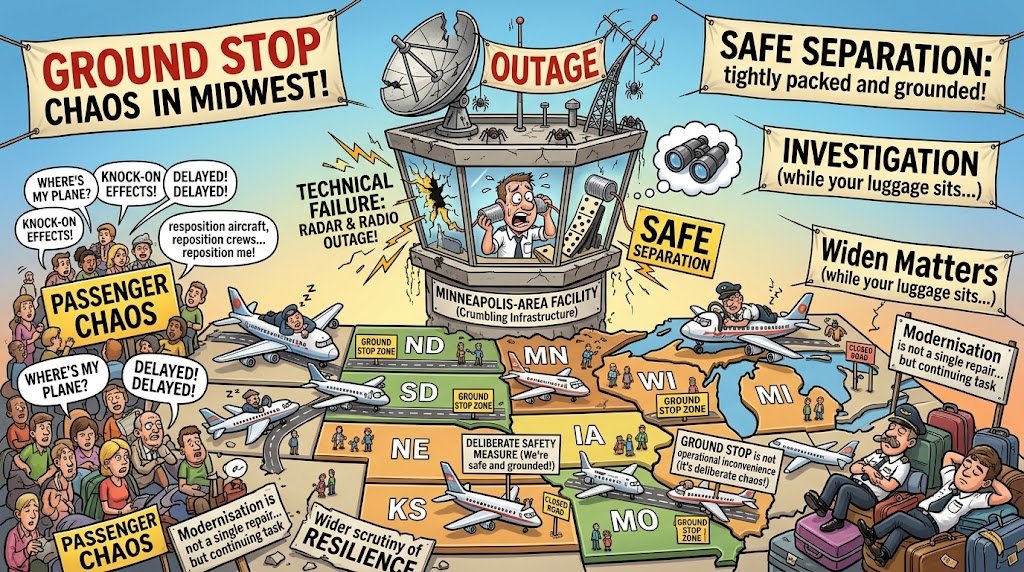
A major air traffic control outage temporarily disrupted flights across nine Midwestern states after radar and radio communications failed at a Minneapolis-area facility that manages roughly 330,000 square miles of airspace.
The Federal Aviation Administration imposed restrictions that held departures on the ground, diverted some flights and limited arrivals as controllers lost essential tools used to track aircraft and communicate with pilots.
The disruption affected airspace far beyond Minneapolis–Saint Paul International Airport, reaching parts of Minnesota, Michigan, Wisconsin, the Dakotas, Nebraska, Kansas and Missouri.
The systems later returned to service, allowing normal operations to resume.
Delays, however, continued after the technical failure was resolved because aircraft, crews and passengers had already been displaced across a tightly scheduled network.
At Minneapolis–Saint Paul, delays averaged about 90 minutes during the evening, while other airports in the region also experienced knock-on effects.
The incident illustrates why a failure at one air traffic facility can quickly become a regional problem.
Commercial aviation depends on continuous coordination between pilots and controllers.
Radar helps controllers see aircraft positions and maintain safe separation; radio communications allow them to issue instructions, clear departures and manage changing conditions.
When either system is unavailable, the safest response is to sharply reduce traffic until reliable control can be restored.
A ground stop is therefore not simply an operational inconvenience.
It is a deliberate safety measure.
Airlines cannot solve the problem by routing around it in the way a car can avoid a closed road.
Aircraft need approved routes, controlled airspace and confirmed landing capacity at their destination.
A disruption at a centre responsible for a large region can affect flights that are hundreds of miles away.
The cause remained under investigation after service was restored.
Initial accounts described an equipment or telecommunications failure, but officials had not publicly established a final explanation.
The incident should not be treated as evidence of a specific technical fault until that investigation is complete.
It also arrived amid wider scrutiny of the resilience of U.S. air traffic infrastructure.
The system relies on a large, interconnected network of radar, communications, software, navigation equipment and trained controllers.
Modernisation is not a single repair but a continuing task: replacing ageing components, building redundancy and ensuring that a local failure does not remove several critical layers of communication at once.
For travellers, the practical lesson is less dramatic but immediate.
Even when a disruption lasts only a short time, its effects can persist through the rest of the day as airlines reposition aircraft and crews.
The immediate emergency has passed, but the investigation now matters because the reliability of the air traffic system depends on understanding precisely why radar and communications failed together.
The Federal Aviation Administration imposed restrictions that held departures on the ground, diverted some flights and limited arrivals as controllers lost essential tools used to track aircraft and communicate with pilots.
The disruption affected airspace far beyond Minneapolis–Saint Paul International Airport, reaching parts of Minnesota, Michigan, Wisconsin, the Dakotas, Nebraska, Kansas and Missouri.
The systems later returned to service, allowing normal operations to resume.
Delays, however, continued after the technical failure was resolved because aircraft, crews and passengers had already been displaced across a tightly scheduled network.
At Minneapolis–Saint Paul, delays averaged about 90 minutes during the evening, while other airports in the region also experienced knock-on effects.
The incident illustrates why a failure at one air traffic facility can quickly become a regional problem.
Commercial aviation depends on continuous coordination between pilots and controllers.
Radar helps controllers see aircraft positions and maintain safe separation; radio communications allow them to issue instructions, clear departures and manage changing conditions.
When either system is unavailable, the safest response is to sharply reduce traffic until reliable control can be restored.
A ground stop is therefore not simply an operational inconvenience.
It is a deliberate safety measure.
Airlines cannot solve the problem by routing around it in the way a car can avoid a closed road.
Aircraft need approved routes, controlled airspace and confirmed landing capacity at their destination.
A disruption at a centre responsible for a large region can affect flights that are hundreds of miles away.
The cause remained under investigation after service was restored.
Initial accounts described an equipment or telecommunications failure, but officials had not publicly established a final explanation.
The incident should not be treated as evidence of a specific technical fault until that investigation is complete.
It also arrived amid wider scrutiny of the resilience of U.S. air traffic infrastructure.
The system relies on a large, interconnected network of radar, communications, software, navigation equipment and trained controllers.
Modernisation is not a single repair but a continuing task: replacing ageing components, building redundancy and ensuring that a local failure does not remove several critical layers of communication at once.
For travellers, the practical lesson is less dramatic but immediate.
Even when a disruption lasts only a short time, its effects can persist through the rest of the day as airlines reposition aircraft and crews.
The immediate emergency has passed, but the investigation now matters because the reliability of the air traffic system depends on understanding precisely why radar and communications failed together.